
How to Make a Resume for Students With No Experience

Written by Vishal Kumar
BBA Student & SEO Learner
Introduction
A resume for students with no experience can feel difficult to create, especially for college students and freshers. However, you can still create a strong resume by highlighting your education, skills, projects, certifications, and other relevant experiences. This guide will show you how to create a simple and professional resume even if you do not have previous job experience.
Creating a resume can be a bit confusing for college students, especially when they lack formal work experience. Many students feel they have nothing substantial to include. However, a student’s resume does not rely solely on work experience.
If you are a college student who hasn’t held a job yet, you can highlight your education, skills, academic projects, certifications, extracurricular activities, and internship-related experiences.
In this guide, we will explore—in simple terms—how to create a resume for students with no experience, what to include, which format to use, and how freshers can make their resumes stand out.
If you are exploring career-related resources, you can also visit our Career & Resume page for more useful guides.
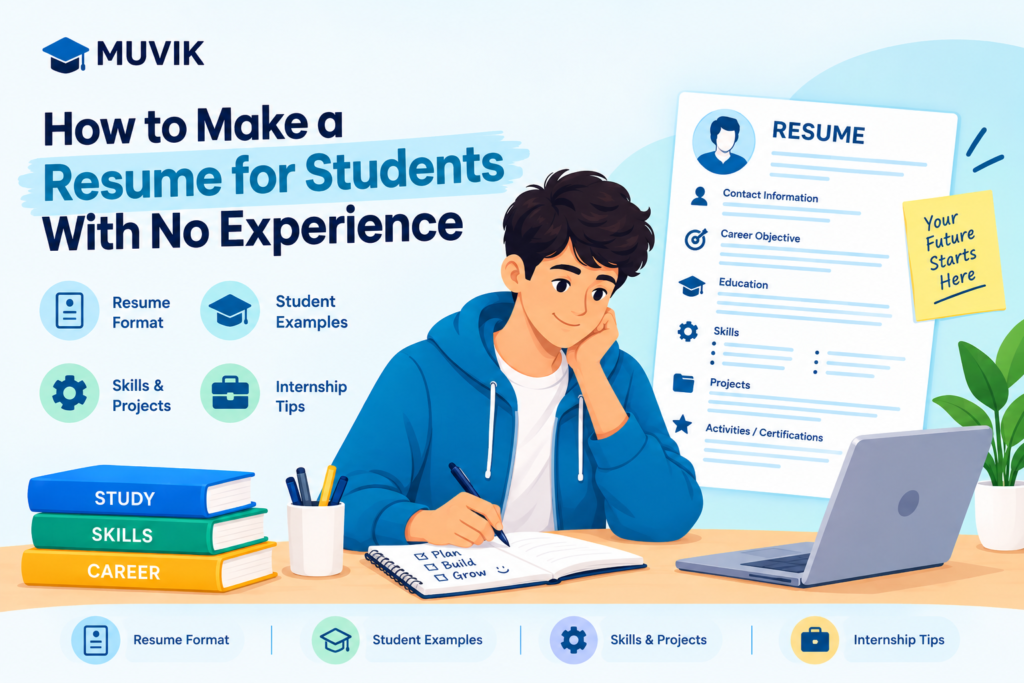
What Should a Resume for Students With No Experience Include?
The most important thing when creating a student resume is ensuring the information is clear and relevant. A lack of work experience does not mean the resume should be empty.
A well-structured resume for students with no experience can help you present your skills, education, projects, and achievements clearly.
A basic student resume can include the following sections.
Contact Information
You should place your basic contact information at the very top.
This includes:
- Full name
- Phone number
- Professional email address
- City/location
- LinkedIn profile ( if available )
Your email address should be simple and professional. There is no need to include unnecessary personal information.
Career Objective or Summary
If a student has no prior work experience, adding a brief career objective can be beneficial.
In this section, you can explain the type of opportunity you are applying for and highlight your key skills.
The objective should not be overly long; explaining the student’s goal and relevant strengths in just 2–3 lines is sufficient.
Example scenario:
A college student applying for an internship or an entry-level position wants to highlight their communication skills, teamwork, and basic computer skills.
Education
For a student without work experience, the education section of the resume is important.
Here, you can mention:
- Degree/course
- College/university
- Year or expected graduation year
- Relevant academic details
If there is any relevant academic achievement, you can mention that briefly as well.
Skills
If you lack experience, showcasing your skills effectively becomes even more important.
Instead of simply listing a random array of skills, include only those relevant to the target role or internship.
For example:
- Communication
- MS Excel
- MS Word
- Presentation
- Basic research
- Teamwork
- Time management
If you have basic knowledge of any software or tool, you can mention it as well, provided it is relevant.
Projects and Academic Work
College students may lack professional work experience, but they often have academic projects to their credit.
Including these projects in a resume demonstrates that the student has gained practical experience working on a specific topic.
For each project, you can briefly explain:
- The project title
- The work you performed
- The skills or tools utilized
- The result or output
Example in the context of MUVIK:
If a student has completed a marketing-related project in college, they can highlight skills such as research, presentation, data collection, or report preparation.
Internships and Extracurricular Activities
If a student has completed an internship, it can be highlighted in a section relevant to work experience.
If no internship has been undertaken, relevant extracurricular activities, college events, volunteering, competitions, or student organizations can be mentioned instead.
However, include only those activities that are relevant to the purpose of the resume.
How to Write a Resume With No Work Experience
The most common issue when lacking work experience is that students often do not know what to include in their resumes.
Therefore, in this situation, the focus should not be on creating experience, but rather on effectively showcasing existing education, skills, projects, and activities.
Highlight Your Education
If you are a fresher, clearly display your educational details on your resume.
Properly format your degree, college name, and expected year of graduation.
You can also include any relevant subjects or academic achievements that are related to the opportunity you are targeting.
Add Relevant Skills
Select your skills based on the job or internship description.
For instance, if the internship requires basic Excel knowledge and you possess that skill, you can clearly mention it.
This allows the recruiter to quickly understand what useful skills the student has.
Include College Projects
For a fresher, a college project can serve as useful proof that the student has worked on a practical task.
Instead of just listing the project name, provide a brief description of your contribution to the project.
Mention Internships, Volunteering, or Activities
If you do not have any formal job experience, you can highlight relevant internships, volunteering, or college activities.
For example, organizing a college event can demonstrate teamwork, communication, and coordination skills.
Write a Simple Career Objective
Keep your career objective specific instead of filling it with generic lines.
Us:
Who you are + what opportunity you want + what relevant skills you bring
You can use this simple formula.
Student Resume Example for Freshers
Looking at a simple example makes it easier to understand the structure of a student resume.
A fresher student’s resume can be organized in this way:
Sample Resume Structure
Name
Contact Information
Career Objective
Short 2–3 line objective.
Education
degree/course
College/university
Expected graduation year
skills
Relevant technical and soft skills.
Academic Projects
Project name + short description + skills used.
Certifications/Activities
Relevant certifications, college activities or achievements.
Optional: Internship/Volunteer Experience
If available ho to relevant details.
How to Format a Student Resume
Along with good content, the resume format is also important. It is better to keep a student resume simple, clean, and easy to read rather than using a complicated design.
Keep the Resume Simple
There is no need to use unnecessary graphics, excessive colors, or complicated layouts in your resume.
Divide the information into clear sections.
Use Clear Headings
Use clear headings for sections like Education, Skills, Projects, and others.
This allows recruiters to quickly scan the resume.
Choose an Easy-to-Read Font
Use a readable font and keep the font size consistent.
You shouldn’t compromise readability just to make the resume look attractive.
Keep the Information Relevant
It is not necessary to include every piece of information in your resume.
Prioritize the information that is relevant to the target job, internship, or opportunity.
How to Create a Resume for a Student Internship
When creating a resume for an internship, a student should focus on their learning ability, skills, projects, and relevant academic work.
What to Include
Internship resume in:
- Education
- Relevant skills
- academic projects
- Certifications
- Relevant activities
Can be included.
What If You Have No Internship Experience?
Not having internship experience is not a problem.
Students can demonstrate their capabilities by effectively showcasing their projects, coursework, skills, certifications, and relevant activities.
Common Mistakes Students Should Avoid
Students often make some common mistakes when creating their resumes that can make them appear less professional.
Adding Fake Experience
If you don’t have experience, you shouldn’t add fake experience.
Properly present only what you have actually done.
Adding Too Much Information
Instead of making your resume unnecessarily long, focus on relevant information.
Using an Unprofessional Email Address
It is better to use a professional-looking email address.
Ignoring Spelling and Grammar
Make sure to check the spelling and grammar before submitting your resume.
Using an Overly Complicated Design
The purpose of a resume is to present information clearly. The design should not obscure the information.
Final Tips for Creating a Student Resume
At the end you can see a short checklist:
- By checking contact details
- Education properly mention
- by adding relevant skills
- Academic projects include
- By mentioning relevant activities/certifications
- Keep resume formatting consistent
- By checking spelling and grammar
- By highlighting relevant information according to job/internship
- Fake information not added A student’s resume shouldn’t be empty just because they lack work experience. You can create a useful resume by properly organizing details such as education, skills, projects, certifications, and relevant activities.If you are a student creating your first resume, start with a simple format and highlight information relevant to each specific application.